 We are living in strange times indeed, when depositing and collecting children at school gates seems a distant memory.
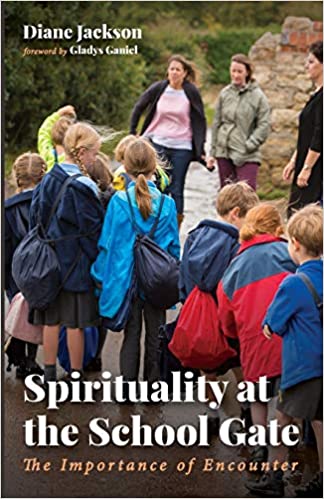
Yet a new book by Diane Jackson, Spirituality at the School Gate (Wipf and Stock 2020), could prove helpful reading during these times (and beyond). It is a study in the spirituality of the everyday, encouraging readers to slow down and discover where God is working in the most everyday or mundane of settings.
Spirituality at the School Gate is a product of Jackson’s research for a master’s in applied spirituality from Waterford Institute of Technology. This masters is hosted and supported by the Spirituality Institute for Research and Education (SpIRE) in Dublin.
The book also draws on her own experiences as a mother of three daughters, living in Dublin.
While written in an accessible style, it also contributes to the scholarly study of ‘everyday religion’ in Ireland.
I was asked to write a Foreword for the book, which I’ve reproduced below, with permission, as it provides my review and reflections on the book.
Foreword by Gladys Ganiel
In Spirituality at the School Gate, Diane Jackson uncovers the exceptional in the everyday, alerting us to insights that should become central to our understanding of the spirituality of motherhood and women’s relationships.
Jackson makes a compelling case that women’s experiences as they deposit and collect children at school gates can be sites for meaningful human (and divine) encounters. Jackson’s own experience of discovering this for herself was the inspiration for her study. It motivates her to collect and compare other women’s experiences, in the process alerting scholars of ‘everyday religion’ to a site of women’s spirituality that they had previously overlooked. Jackson’s own honesty about her struggles to recognize the school gate as an opportunity for divine encounters gives her scholarship a rare, engaged intentionality.
Feminist scholars of religion and mothers- of-faith, regardless of whether or not those two categories overlap, have long realized that women’s experiences of religion have been overlooked and undervalued. The seemingly mundane task of school gate duty, which Jackson quite accurately describes as a part-time job in and of itself, provides a locus around which women share their experiences. One of this book’s most important contributions is the voice it gives to those women, in the process honouring their role in nurturing their own and their families’ spiritual lives, and in passing faith on to the next generation.
Jackson acknowledges that her research is exploratory and based on a small, limited sample. But it makes valuable contributions in several areas.
Studies of everyday religion in Ireland are very rare; Spirituality at the School Gate begins to paint a picture of the everyday spirituality of mothers from (evangelical) Protestant traditions.
Likewise, studies of the role of women in religion in contemporary Ireland are limited; Spirituality at the School Gate reminds us that this could be burgeoning field of study.
Further, there are few studies that really seek to understand how Christianity is surviving in a rapidly-secularizing Ireland; Spirituality at the School Gate gives us new perspectives on how people for whom faith is important negotiate that aspect of their identity amid rapid social and religious change.
Finally, in her quest to integrate the sociology of religion and practical theology, Jackson has an important message for readers beyond the academy.
These are the mothers who, like her previous self, have not yet realized that the ground outside the school gate is indeed holy.
There is hope for these women within these pages, which must only serve as an encouragement towards the enrichment of their own spiritual lives.