 I have three recent publications which may be of interest to readers of this blog.
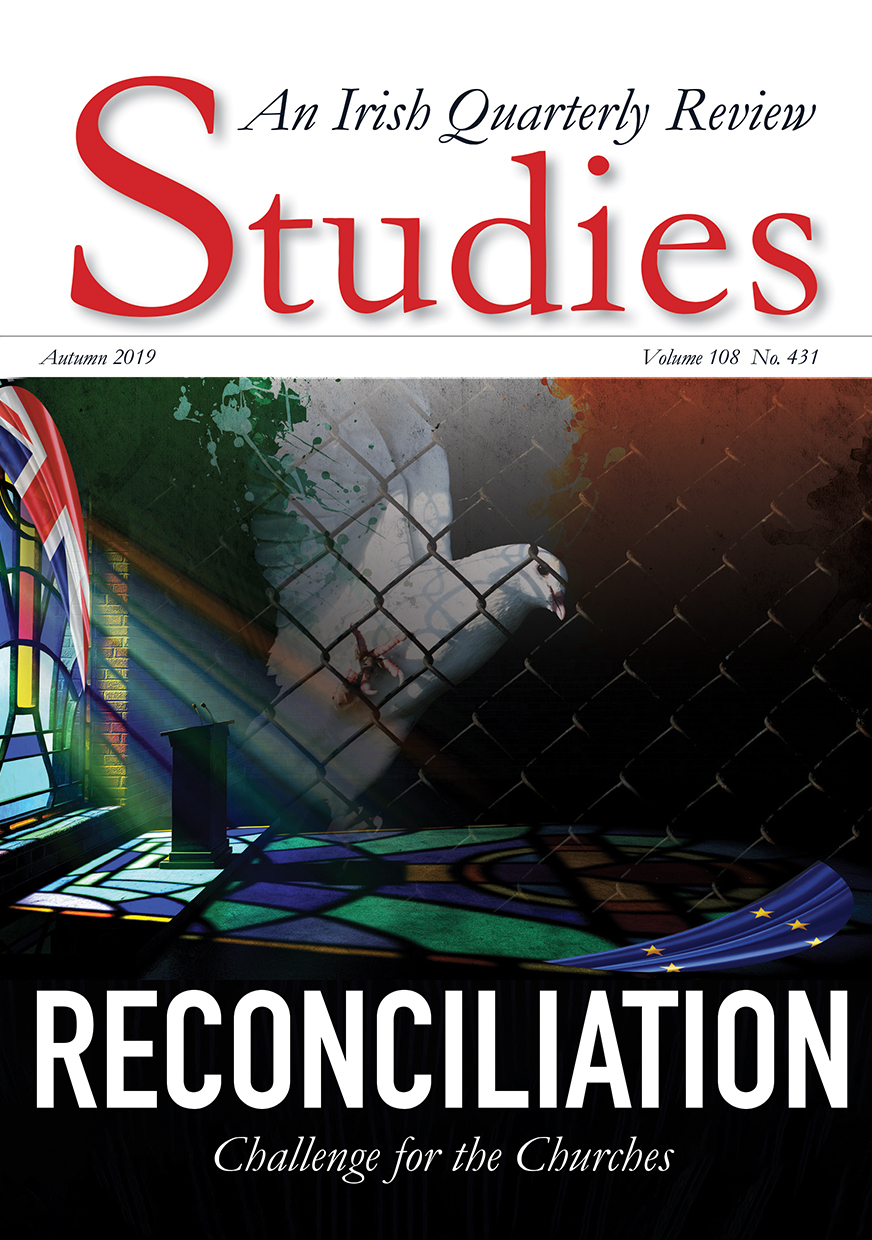
‘Surveying Ireland after the Pope: Grounds for Cautious Optimism?’ is in the current issue of Studies: An Irish Quarterly Review (Autumn 2019).
Studies is available in some bookshops and a single issue can be purchased online for €10. PDFs of individual articles cost €3.
My article was written in response to the previous issue of Studies, a special edition reflecting on Pope Francis’ visit one year on: ‘Goodbye to all that? Ireland after the Pope.’
This is a brief summary of my article:
The contributions in Studies’ special issue, ‘Goodbye to All That? Ireland after the Pope’, offer valuable insights on Francis’ visit and what it reveals about the future of the Catholic Church in Ireland. They share three common assumptions, two of which I wish to challenge based on my own research on Francis’ visit. The assumptions I will challenge are that the media’s preoccupation with the abuse crisis was excessively negative and, as this implies, unfair; and that the visit has been largely inconsequential in the life of the Church. In contrast, my data suggest that taken as a whole, the contributors have offered an assessment of Francis’ visit and the future of the Church that is bleaker than may be warranted. I will not challenge the third assumption – that there are signs of vitality still within the Church – because I also have found such signs in my previous research.
I begin with a methodological description of my research: a systematic narrative analysis of Irish Times coverage of the visit between 1 May-1 September 2018; and a nationally-representative survey about the visit. I then address the two underlying assumptions in turn, explaining how my research challenges or confirms them. I conclude with brief reflections on the future of the Church. While my research challenges the somewhat pessimistic tone of the special issue, my more optimistic reading of the visit is a cautious one that leaves no room for complacency among those who wish for the Church in Ireland to have a future.
In addition, the cover story of this issue of Studies is a well-written reflection on another topic on which my research has been focused, ‘Irish Churches and Reconciliation: Breaking the Bondage of the Past’, by Fergus O’Ferrall.
‘The Strengths and Limitations of the Inclusion of Religious Actors in Peace Processes in Northern Ireland and Bosniz and Herzegovina’, co-authored with Vladimir Kmec was published in International Negotiation, 24(1), pp. 136-163.
This was published in an academic journal so access to a university library is required.
This is the abstract of the article:
This article uses a comparative approach to analyze the strengths and limitations of the inclusion of religious actors in peace and transition processes. It compares the theoretical frameworks of Bercovitch and Kadayifci-Orellana, and Brewer, demonstrating how the first helps us understand the strengths of religious actors, while the second sheds more light on their limitations. An analysis of the involvement of religious actors in the peace processes in Northern Ireland and Bosnia and Herzegovina supports the argument that religious actors are more likely to contribute to peace when they are excluded from Track One negotiations and are active in other modalities of participation: in wider social peace processes at national or grass-roots levels. Religious actors can contribute to peace processes especially if they choose to exclude themselves from Track One negotiations in order to avoid the pitfalls of becoming too closely associated with political power.
‘Religious Practice in a Post-Catholic Ireland: Towards a Concept of Extra-Institutional Religion’, has been published in Social Compass, https://doi.org/10.1177/0037768619868418
This article builds on and refines the concept of ‘extra-institutional religion’ which I put forward in my 2016 book, Transforming Post-Catholic Ireland.
This article was published in an academic journal so access to a university library is required. However, the journal’s open access policy allows for a pre-proof version to be posted online.
Read the whole article here.
This is the abstract:
This article develops the concept of ‘extra-institutional religion’ to describe how some religiously committed individuals practise religion in a ‘post-Catholic’ Ireland. Rooted in an island-wide study, it describes extra-institutional religion as the practice of religion outside or in addition to the Catholic Church, Ireland’s historically dominant religious institution. As a new concept, extra-institutional religion provides an alternative to the theoretical emphasis on religious individualisation advocated by sociologists of religion and general theorists like Ulrich Beck. It builds on the concepts of British sociologists of religion Grace Davie (‘believing without belonging’ and ‘vicarious religion’) and Abby Day (‘believing in belonging’ and ‘performative religion’). It argues that extra-institutional religion may have application outside Ireland in the mixed religious markets of Europe. Extra-institutional religion also may contribute to wider change by balancing its two structural strengths: its position on the margins, and its continued links with institutional religion.